How to ask for a second opinion on a cancer diagnosis
You have a diagnosis and a treatment plan. How do you know the plan is right? How to ask for a second opinion, what it costs and what to bring.
You have a diagnosis. And a treatment plan already waiting.
The appointment was short. A plan was on the table. Perhaps surgery, perhaps chemotherapy, perhaps radiotherapy. You went home with a folder of paper and a date.
Then comes the question almost everyone has, and few people say out loud. Is this plan right? And how would I know?
A second opinion is how you find out. This article covers what it changes, what it costs and what you need to bring.
In short
| 45.3% | of Dutch breast cancer patients had at least one difference of opinion after a second opinion [1] |
| 29.1% | had a difference the researchers called major, such as breast-conserving surgery instead of a mastectomy [1] |
| 35% | of oncology second opinions led to a different treatment with a better expected outcome [2] |
Three moments when people ask
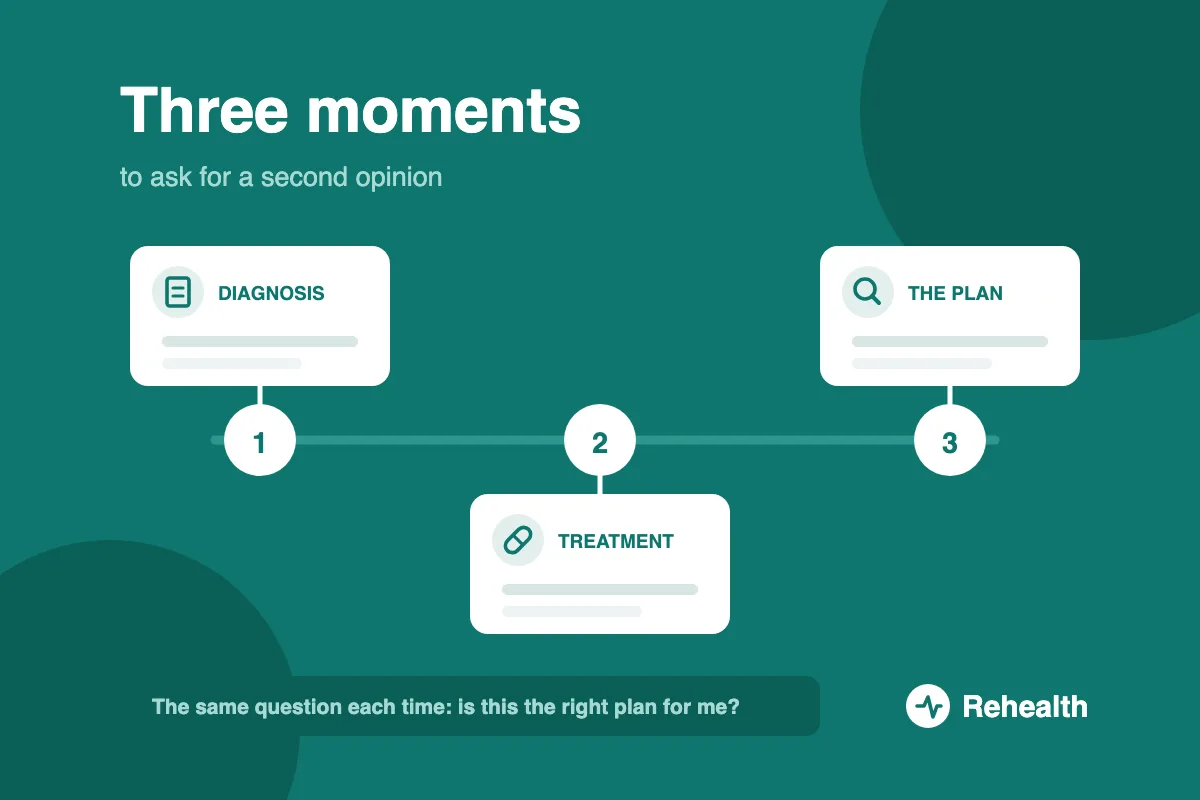
Not every moment is equally useful. These are the three where a second view gives you most.
- The diagnosis is new. You have the words. You do not have the picture yet.
- Treatment is about to start. Before chemotherapy, radiotherapy or surgery begins, not after.
- The plan deserves a check. Diagnosis, pathology and imaging, read against current approaches.
In all three the question is the same. Is this the right plan for me?
If the decision is already made and you are content with it, a second opinion gives you least.
A second opinion is not a complaint about your doctor
This is what stops most people. They worry the doctor will take it personally, or that the relationship with the hospital will suffer.
In oncology a second view is simply part of the work. Cancer care already goes through a tumour board, where several specialists look at the same file. A second opinion is the same idea, just outside your own hospital.
And often the second doctor confirms the plan. That is an answer too. You start a hard treatment without carrying the doubt with you.
How often does something actually change?
Two studies give an honest sense of the scale.
A Dutch study looked at 591 breast cancer patients who asked for a second opinion. Of those, 470 had not started treatment. For 213 of them the second view differed, which is 45.3%. For 137, or 29.1%, the difference was major. Think of chemotherapy before surgery instead of operating first. Or breast-conserving surgery instead of a mastectomy [1].
A second study reviewed 120 oncology cases across four diseases. In 13 cases, 11%, the diagnosis changed in a way that mattered clinically. In 42 cases, 35%, the treatment changed, with a better expected outcome [2].
Read those numbers carefully. They are not error rates for your hospital. People ask for a second opinion when a case is already difficult, and that pushes the figures up. What they do show is that it is not an empty exercise.
How to ask for one
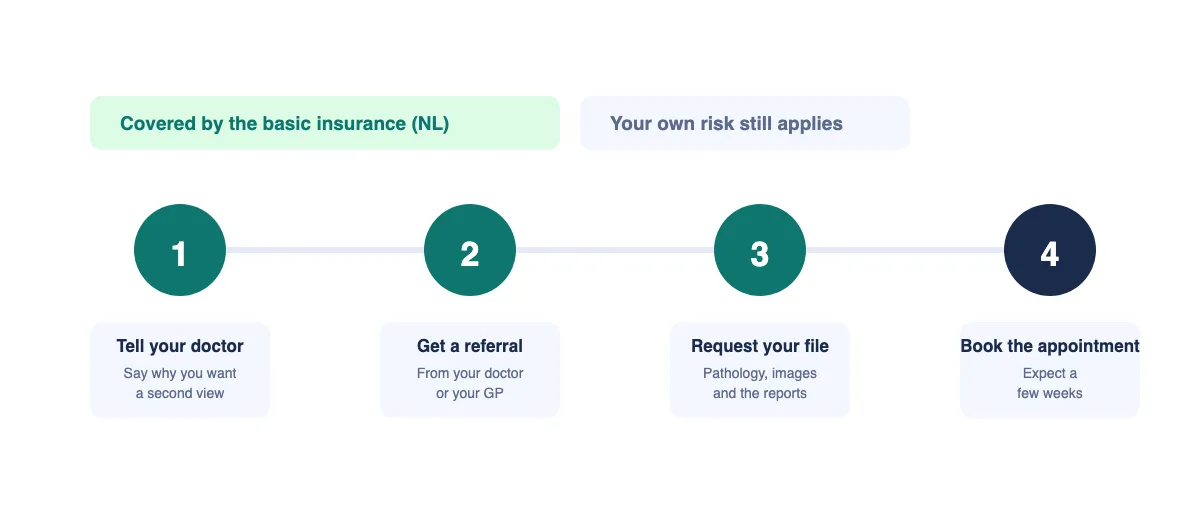
The path is the same in most European systems. Four steps, none of them complicated.
- Tell your own doctor. Say why you want a second view. It makes the conversation easier and your doctor can suggest where to go.
- Get a referral if your system needs one. In the Netherlands you do. Your treating doctor or your GP writes it. A doctor may not refuse it without a good reason.
- Request your medical file yourself. Ask for the reports, the pathology results and the images themselves, not only the summary.
- Book the appointment. Expect a few weeks before you can be seen at another hospital [3].
What it costs
In the Netherlands a second opinion is covered by the basic insurance and there is no patient contribution. Two things still catch people out.
- Your own risk still applies. If you have not used it yet, that part comes out of your pocket.
- The hospital needs a contract with your insurer. Without one you may pay the bill, or part of it. Ask your insurer first [3].
Rules differ by country, so check yours before you book. The question to ask is simple. Is this hospital covered, and what will I pay myself?
Going abroad for a second opinion
Some people look across the border, often for a centre that sees their specific tumour more often.
That is possible, but the rules change. Care abroad is not covered automatically. For planned care inside the EU you usually need prior approval from your insurer. What comes back depends on your policy.
Ask your insurer three things, in writing. Is this hospital covered? How much do I get back? Do I need approval first? Without those answers you do not know your own costs.
If you want the opinion rather than the treatment, travel is often unnecessary. An online second opinion answers the same question from the file you already have.
| At home | Abroad, inside the EU | |
|---|---|---|
| Referral | Needed in the Netherlands | Ask what the hospital requires |
| Cover | Basic insurance, no patient contribution | Not automatic. Depends on your policy |
| Prior approval | Not needed | Usually yes, ask in writing |
| Own risk | Applies | Applies, plus anything not covered |
| Travel | To another hospital | Abroad, or online instead |
Unsure about the plan in front of you?
Send your reports. A doctor reads them before you speak. From €50.
Request a second opinionWaiting for an appointment is not lost time
Few people know this. Your file can be reviewed while you wait for the appointment at your own hospital.
Your place in the queue does not change. A second opinion does not move you up a waiting list, and that is not the point. The point is to sit down with a complete picture when your turn comes.
What to bring to the consultation
The fuller the file, the more concrete the answer. This is what an oncologist needs:
- The diagnosis: cancer type, the organ involved, date and stage, and whether it has spread.
- The pathology report, with IHC results and molecular tests if you have them. This is the single most important document.
- The images themselves as DICOM files, plus the radiology reports. Not only the summary.
- Previous treatment and surgical reports, with the pathology from them.
- Recent lab results: blood count, liver and kidney function, and tumour markers where relevant.
- Your situation now: symptoms, medication, allergies and other conditions.
- Your own questions, written down. In the consultation you will forget them otherwise.
This list comes from the intake form of our partner hospital’s oncology department. Sending a complete file the first time is the one thing that genuinely speeds it up. If something is missing, ask the medical records office again. In Europe you have the right to a copy of your own file.
How it works at Rehealth
We are a Dutch company in Leiden. Whatever you write to us about cancer, the first answer comes from Dr. Fikret Asarcıklı. Not a coordinator and not a sales desk.
That first conversation is free, and no medical advice is given in it. He listens, goes through your reports and says which route fits you.
If you choose the second opinion, this is how it runs. His own field is paediatric haematology and oncology. Inside it, he gives the opinion himself for a fixed €50. Outside it, he does not guess. He finds the right oncologist for your cancer type. A slot is then opened for that doctor on the platform.
You upload the file in the app, not by email or a chat app. It sits under European privacy rules and you choose what you share. The doctor reads everything before the call, so the time goes to your questions.
The consultation is in English or in Turkish. Afterwards you download the opinion as an epicrisis report in PDF. You share that with your own team.
⭐ Do you later take a treatment package at that hospital? Then you get back what you paid their doctor for the second opinion.
There is more on the oncology and cancer care page. Is your question about the images rather than the whole file? Then read a second opinion on your scan.
An online second opinion does not replace the doctor treating you. It is one more view, before a decision that is hard to undo.
Frequently asked questions
Do I need a referral for a second opinion?
In the Netherlands, yes. Your treating doctor or your GP writes it, and a doctor may not refuse without a good reason. Rules differ elsewhere, so check your own system.
Is a cancer second opinion covered?
In the Netherlands it comes out of the basic insurance with no patient contribution. Your own risk still applies, and the hospital needs a contract with your insurer.
How long does it take?
Expect a few weeks for an appointment at another hospital. An online second opinion is usually faster, because there is no waiting list in between.
Do I need new scans or tests?
Usually not. A second opinion works from the file you already have. New tests are only needed if the doctor says the data is too old or incomplete.
What if the second doctor agrees with the first?
That is a useful result. You begin treatment knowing the plan held up when someone else looked at it.
References
[1] Heeg E, Civil YA, Hillen MA, Smorenburg CH, Woerdeman LAE, Groen EJ, Winter-Warnars HAO, Vrancken Peeters MTFD. Impact of Second Opinions in Breast Cancer Diagnostics and Treatment: A Retrospective Analysis. Annals of Surgical Oncology, 2019. View the study →
[2] Lipitz-Snyderman A, Chimonas S, Mailankody S, et al. Clinical value of second opinions in oncology: A retrospective review of changes in diagnosis and treatment recommendations. Cancer Medicine, 2023;12:8063-8072. View the study →
[3] Kanker.nl. Second opinion bij kanker. Read the patient information →